
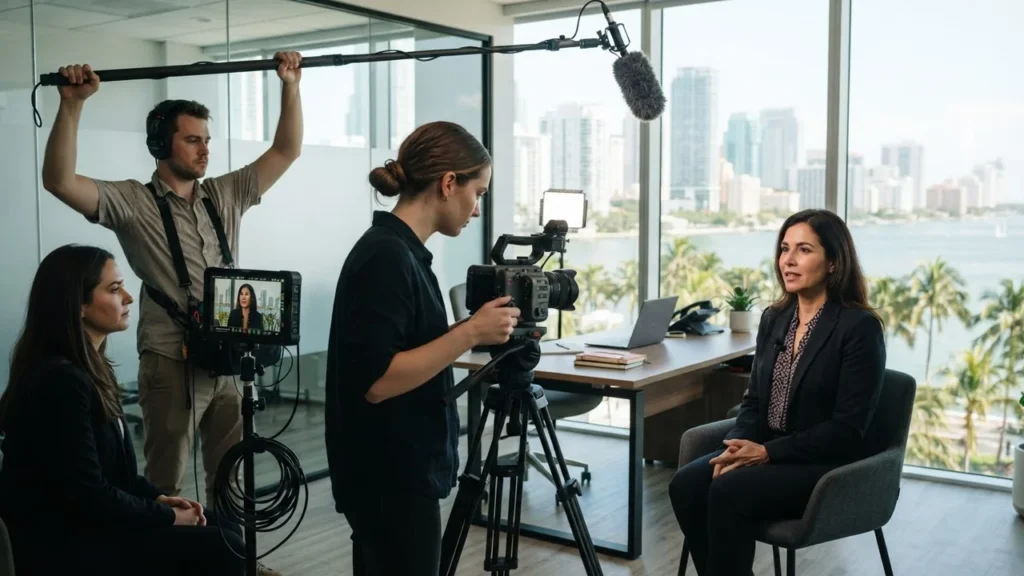
Video production is the process of planning, filming, and editing video content around a defined business goal, and it works when every stage has an owner and an approval. In Miami, that process also has to serve bilingual audiences, seasonal tourism, and buyers who decide fast.
Most companies that end up unhappy with a video did not fail at the camera. They failed earlier, when nobody defined the objective, the audience, or who signs off. This guide walks through the stages of a project and what to expect at each one.
For the full scope of what AMD delivers, review the video production service before you brief anyone.
What does video production for businesses in Miami include?
Video production for businesses in Miami includes four connected phases: strategy and pre-production, filming, post-production, and distribution. Each phase produces a deliverable that feeds the next one, and skipping any of them shows up on screen.
The strategy phase answers why the video exists and who it is for. Pre-production turns those answers into a script, a shot list, a schedule, and a budget. Filming captures the material. Post-production shapes it into something watchable, and distribution decides where it lives and how it gets measured.
In this market, one more layer matters: language. A video that will run across Miami-Dade often needs an English version and a Spanish version, with talent and phrasing that feel native in both. Subtitles alone rarely carry the same weight as a properly adapted script.
The stages of a video production project
A video production project moves through pre-production, production, post-production, and distribution. Each stage closes with an approval before the next one starts, which is what keeps revisions from multiplying at the end.
Strategy and pre-production
Everything that determines whether the video works gets decided here. The team defines the objective, the audience, the key message, and the channel where the video will run. From there come the script, the storyboard, the locations, and the shooting schedule.
Approval at this stage is the cheapest one you will ever give. A script change costs a conversation. The same change after filming costs a reshoot, a new schedule, and a second round of editing.
Filming
On set, the crew handles lighting, sound, direction, and continuity. Your team handles access, on-camera participation, and quick decisions about details that only the business can resolve. A realistic schedule leaves room for retakes and for the interruptions that always appear.
Sound deserves specific attention. Poor audio makes a well-shot video feel amateur, and it is the most common technical complaint from viewers. Confirm how the crew records dialogue and how they handle noisy locations.
Post-production
Editing builds the story, then color, sound design, graphics, and subtitles finish it. This is where feedback rounds need structure: one consolidated set of comments per round, from one decision maker, beats scattered notes from five people.
Ask early how many revision rounds are included and what counts as a new version rather than a revision. That single question prevents most billing surprises.
Distribution
A finished file is not a campaign. Distribution covers the cutdowns for social, the captions, the thumbnail, the versions for each platform, and the plan for paid placement. Decide this before the edit, because the edit should leave room for those versions.
How long does a corporate video project take?
Timeline depends on three variables: the number of locations and people involved, the number of approval rounds the script needs, and the number of final versions you require. A single interview-led corporate video moves faster than a multi-location campaign with actors and permits.
Ask for a schedule with named milestones and approval dates, not a single delivery date. Most delays come from the client side, usually because the person who signs off was never identified at the start.
| Stage | What it decides | Your involvement | What you approve |
|---|---|---|---|
| Strategy and pre-production | Objective, audience, message, format | High: subject input and access | Script and shot list |
| Filming | How the message looks and sounds | Medium: on-camera time and locations | Footage review |
| Post-production | Pace, tone, clarity, and branding | Medium: consolidated feedback | First cut and final cut |
| Distribution | Where the video runs and how it is measured | Medium: channels and media budget | Cutdowns, captions, thumbnails |
What should you look for in a video production company in Miami?
A video production company in Miami should offer three things: a documented process with defined approvals, genuine bilingual capability, and a plan for what happens after delivery. A strong reel gets attention, but process is what protects your budget.
Ask who owns the raw footage and the final files. Ask how feedback rounds work and who consolidates them. Ask whether the team can produce Spanish and English versions with native talent, not just subtitles. Ask what the deliverables include: vertical cuts, captions, stills for the website.
Budget follows scope, so compare proposals on what they include rather than on the headline number. A quote that covers one edit and no cutdowns is not the same product as one that covers the full set of platform versions.
Local context helps too. A team that understands Miami’s mix of hospitality, real estate, healthcare, logistics, and Latin American trade can suggest locations, talent, and formats that fit the audience instead of guessing.
A corporate video usually carries the highest expectations, because it represents the whole company. Treat the script as the most important deliverable of the project, and give yourself enough time to review it properly.
Where video production fits in your marketing plan
Video production works best when it connects to the rest of your marketing: the website, the social calendar, the sales deck, and the ads. A video produced in isolation gets watched once and then sits in a folder.
Plan the cutdowns alongside your social media management calendar, so each platform gets a version built for its format. The article on video formats that work on social media explains which lengths and structures fit each channel.
If your priority is the company story, read how to tell your company story with a corporate video before writing the script. And if you need consistent stills for the website and press materials, pair the shoot with professional photography for your brand. Both assets then share the same visual language.
AMD is a digital marketing agency in Miami that connects audiovisual work with strategy, media, and content. That combination is what turns a shoot into a campaign with a measurable purpose.
Build a video plan your team can actually approve
Good video production starts with decisions, not equipment. Define the objective, name the person who approves, agree on the number of versions, and plan distribution before the first shooting day. Everything else follows from those four choices.
If you are planning a project in Miami, review AMD’s video production service and start with a clear scope. A short conversation about objective and channel saves weeks later.
Frequently Asked Questions
How much does video production cost in Miami?
Cost depends on scope: number of shooting days, locations, on-camera talent, animation, number of versions, and how many languages you need. Instead of comparing headline prices, ask each provider to itemize what is included and what is billed separately.
A proposal with a defined scope and approval process is easier to budget than a low estimate with open items.
Do I need a video production company, or can I film it myself?
You can film simple internal content yourself. A video production company adds value when the piece represents the brand publicly, needs consistent audio and lighting, involves multiple locations, or must exist in more than one language.
In those cases, the cost of a reshoot usually exceeds the cost of hiring a crew once.
What is the difference between a corporate video and a social media video?
A corporate video explains who the company is, how it works, and why it matters, and it usually lives on the website and in sales conversations. A social media video is built for a feed: shorter, faster to the point, and designed for the first seconds.
One shoot can feed both if you plan the versions in advance.
Can one shoot produce both English and Spanish versions?
Yes, when the script and the schedule allow for it. Plan two takes of each key line, cast bilingual talent when there is on-camera dialogue, and budget the extra editing time. Adapting the message for each audience works better than translating word for word, especially for humor and cultural references.
What should I prepare before the first meeting with a video production company?
Bring the objective, the audience, the channels where the video will run, the internal approval chain, and a rough sense of your budget range. If you have brand guidelines, share them. Clear inputs shorten pre-production and reduce the number of revision rounds later.