
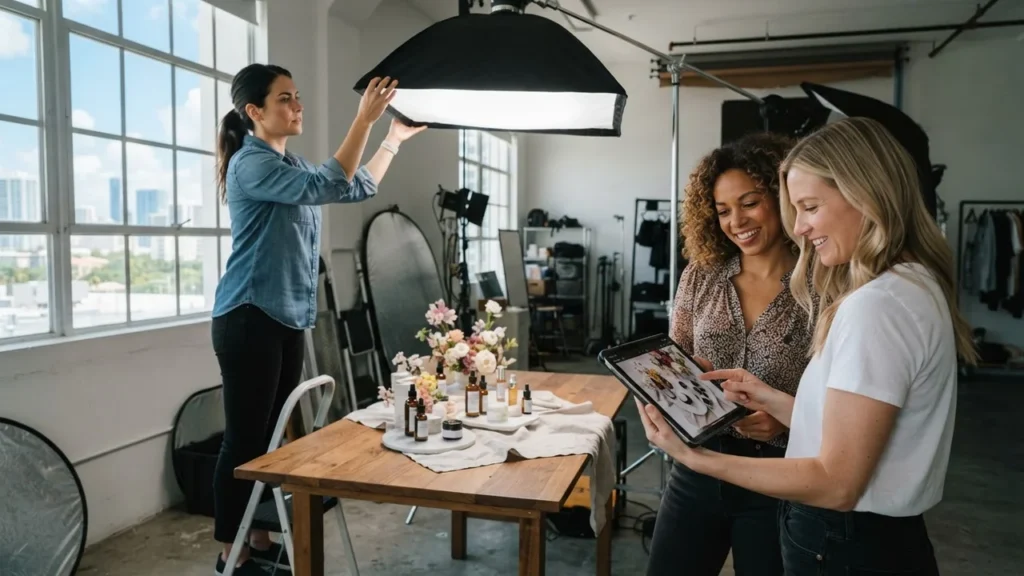
Professional photography is the planned production of images that show a business, its products and its people with a commercial purpose. In Miami, those images often decide whether a customer trusts a brand before reading a single line of copy.
A restaurant in Brickell, a real estate office in Coral Gables and an online store shipping across Latin America all compete for attention on the same small screen. Weak images lose that contest quietly. Strong ones earn the click.
AMD, a digital marketing agency in Miami, works with businesses that need professional photography connected to a wider marketing plan, not a folder of files nobody uses.
What professional photography actually delivers for a business
Professional photography delivers consistency. The same lighting logic, color treatment and framing appear across every image a company publishes, so the brand reads as one business instead of five.
That consistency matters because images travel. A single photo can end up on a website, a Google Business Profile, a paid ad, a menu, a marketplace listing and a printed flyer.
Each surface crops and compresses the file differently. An image shot with intention survives that journey. A phone snapshot taken in a hurry usually does not.
Good photography also saves time. When a business owns a library of approved images, the marketing team stops hunting for something usable before every campaign.
Why do brand images matter more in a bilingual market like Miami?
Brand images carry meaning that words cannot translate. Miami serves customers in English and Spanish, plus visitors and buyers from across Latin America, so a visual language has to work for all of them at once.
Color, framing and the people shown in a photo communicate faster than any headline. A clinic that photographs its actual staff reads as local and real. A generic stock photo reads as a placeholder.
This is where brand images earn their place. They set the tone a business wants associated with its name, and they do it without depending on a single language.
For companies selling to Latin American trade partners, that visual consistency also signals stability. Buyers who cannot visit in person judge a supplier partly by how professional its materials look.
How does product photography turn browsers into buyers?
Product photography answers the questions a shopper cannot ask in person. Scale, texture, finish, color accuracy and how an item behaves in real use are decided by the image, not by the description.
Online, the photo is the product. A buyer comparing two similar items on a marketplace screen picks the one that shows detail clearly and honestly.
That is why product photography is a sales function, not a design task. It reduces hesitation, limits returns caused by mismatched expectations and gives paid campaigns stronger creative to work with.
AMD approaches it that way: the shot list starts from the questions customers ask, then the lighting and angles are built to answer them. For a closer look at how images affect online sales, read this guide on product photography in Miami.
| Shoot type | Main goal | Typical use |
|---|---|---|
| Product photography | Show detail, scale and finish | Online stores, marketplaces, catalogs |
| Corporate portraits | Put a face on the company | Team pages, LinkedIn, press |
| Brand images | Show the service in real use | Social media, ads, landing pages |
| Space and location | Sell the environment | Real estate, hospitality, clinics |
What a professional photography shoot includes
A professional photography shoot starts with a plan, not a camera. The team defines the goal of the images, the surfaces where they will run and the message each one has to carry.
From there comes the shot list. It names every frame the business needs: hero images, detail shots, team portraits, location views and the variations required for ads and social formats.
Production follows: location or studio, lighting, styling, props and direction. Then comes selection and retouching, where color is corrected and distractions are removed without erasing what makes the subject real.
Delivery closes the loop. Files arrive named, sized and organized for web, print and social, so the marketing team can publish without reformatting anything. If the shoot involves people and several locations, this guide on planning a team and brand shoot covers the logistics.
How to choose a photography partner in Miami
A professional photography partner asks about business goals before discussing equipment. The right questions are about audience, channels and what the images need to achieve.
Ask how the work connects to the rest of the marketing. Images that feed a campaign, a landing page or a product launch perform better than a standalone gallery.
Check the process: planning, direction, retouching and delivery formats. A clear process is a better signal than a large portfolio.
Finally, confirm who owns the files and how long they stay available. A business should be able to reuse its own images for years without asking permission.
AMD pairs professional photography with audiovisual production and corporate identity design when a brand needs its visuals to match across every channel.
Frequently Asked Questions
How often should a business update its professional photography?
Whenever the offer, the team or the visual style changes. Product lines move, staff turns over and platforms shift their preferred formats. A practical rhythm is a planned shoot each time a major campaign or product launch is coming, plus small updates in between.
What is the difference between product photography and brand images?
Product photography focuses on a specific item: its detail, scale and finish. Brand images show the company in context, including people, spaces and the way a service is delivered. Most businesses need both, because they answer different questions at different points in the buying decision.
Do I need a studio in Miami for a professional photography shoot?
Not always. A studio gives control over lighting and background, which suits product photography and portraits. Locations, restaurants, offices and job sites often work better on site, because the environment is part of what the customer is buying.
How long does a shoot take from planning to delivery?
It depends on the number of images and the complexity of the setup. A focused product session moves faster than a full brand shoot with several locations and people. Planning usually takes as long as the shoot itself, and it is what keeps the production day efficient.
Can I use the same images for ads, social media and print?
Yes, if they are planned for it. Ask for multiple crops and resolutions at delivery, including vertical formats for social and high-resolution files for print. Planning those formats upfront avoids reshoots later.
Make your images an asset your business owns
Professional photography is not a one-time expense. It is a library a business builds, reuses and updates as it grows, and it keeps working across every channel the company runs.
In a market as visual as Miami, the businesses that look consistent tend to be the ones customers remember. That advantage comes from planning, not from luck.
If your current images no longer match the quality of your work, it is worth fixing. AMD can plan the shoot, direct it and connect the results to your wider marketing. Explore our professional photography service and start with a clear plan for your brand.